Talk: Designing hierarchical connection structures in phase space
Abstract
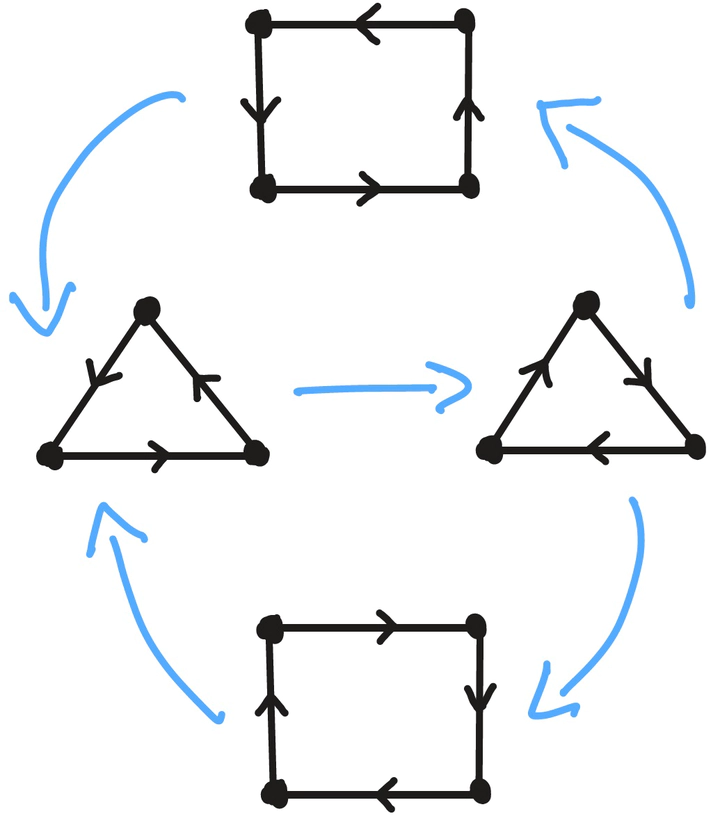
Heteroclinic and excitable dynamics provide a natural mathematical framework for modeling structured intermittent, sequential behavior in complex systems. In many applications, these transitions underlie a specific hierarchy. For example, in neuroscience, a memory may correspond to a sequence of activity, and memory formation corresponds to the modulation of these patterns. In biological or social networks, temporal sequences in collective evolution may change qualitatively due to environmental changes on a higher hierarchical level. In such cases, the system evolves through a sequence of lower-level dynamics—such as local state transitions—before undergoing a qualitative change driven by a higher-level process. In this talk, we present a systematic method to construct vector fields that realize such hierarchical dynamics: given a set of lower-level directed graphs and a top-level digraph encoding transitions between them, we construct a dynamical system where the top-level connections are heteroclinic and the lower-level transitions are excitable with zero threshold. This yields a general framework for modeling systems with multi-scale, hierarchical switching behavior reflecting a prescribed hierarchical structure.

Sören von der Gracht
Mathematician researching dynamical systems
Research in network dynamical systems and their applications.