Talk: Directed hypernetworks: Heteroclinic dynamics and reluctant synchrony breaking
Abstract
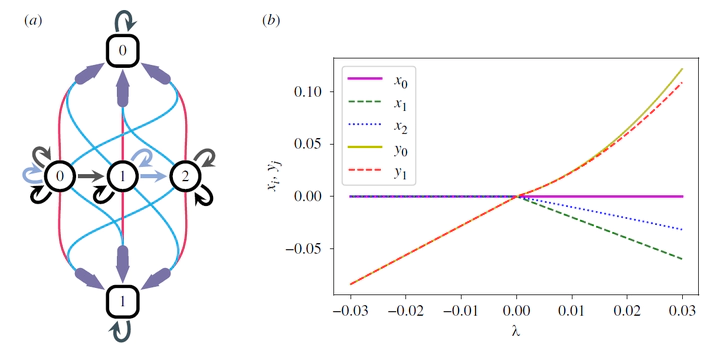
Interconnected real-world systems frequently involve non-pairwise interactions among agents—known as higher-order interactions. Their role is increasingly recognized as crucial in shaping collective dynamics. The higher order interaction structure can be naturally represented using hypergraphs or hypernetworks. This talk explores the dynamics of such hypernetworks, revealing that simple model equations exhibit obstructions to constructing certain heteroclinic structures in phase space when interactions are undirected, while their directed counterparts do not impose such restrictions. Motivated by this, we introduce a general class of directed hypernetworks and define corresponding admissible maps that preserve the underlying interaction structure. For this class, we establish a complete classification of all robust patterns of (cluster) synchrony supported by a given hypernetwork. Remarkably, these robust synchrony patterns are determined by higher-degree polynomial admissible maps. This contrasts sharply with classical networks, where cluster synchronization arises linearly; here, it emerges as a higher-order, nonlinear phenomenon. This nonlinear nature gives rise to a novel type of “reluctant” synchrony-breaking bifurcation, in which a high-order tangency of the solution branch to a non-robust synchrony space causes previously synchronous nodes to separate exceptionally slowly.

Sören von der Gracht
Mathematician researching dynamical systems
Research in network dynamical systems and its applications.